Category Archives: Politics

Taxes

Taxes are all the rage these days–again. What I’ve learned is that lots of people in positions of power avoid them in interesting ways. (Why lower a tax, therefore, if its value is empty. Logical flop, but fun nonetheless.) Who’d have thought that tax on driving would be worth over 100 Grand. I’m sure there’s a deeper story to Daschle’s tax issues , what he calls a “tax laps,” than has been made public, as would probably be the case with most in Congress.

Value is interesting question in whatever market. A service provided on the back of a tax is considered of less value by Republicans because more profit could be had by restructuring it in the market and it comes off as an “entitlement.” Public schools, for example, could be a neat business. But then a “market value” would be established, a windfall for some, an element of scarcity for others. Public learning as scarce commodity. Thrilling.

Shelby wants us to “attack the financial cancer” but has very few ideas beyond the 80’s cliche: cut taxes, the only idea Republicans have apparently. And Sununu’s in a state over some monster of a government policy too difficult to find in the dark. Do I disagree with Shelby and Sununu? Not really. But CT is heading toward a 4 Billion deficit in a few years and it’s not because of lower tax revenue. Causality? That’s a good one.

None of his is poetry or fiction. These are too honest.

Knowledge Use

The Courant has a sad article on mortgage relief in CT.

The Wrights, with yearly income of about $80,000, share a predicament with thousands of families in trouble in Connecticut — many of whom had reason to hope for help from the state. An examination of Connecticut’s mortgage relief programs shows that only a small fraction of homeowners have qualified for aid that was meant to reach many more families.

Even as foreclosures continue by the hundreds, more than $100 million set aside by the state to help families keep their homes is going untapped. The state programs are so narrow and carry so many restrictions that getting approval is nearly impossible.

From what I can gather from the article, there are several programs in CT and each comes with its own set of standards: EMAP, CTFAMILIES, and HERO:

Since July 1, a program to help homeowners make payments on their mortgages has helped one borrower so far, with just five approvals pending. That, despite 382 applications for the program — the Emergency Mortgage Assistance Program, or EMAP.

The centerpiece program, CTFAMLIES, has fared better, with 65 loan refinancings closed, totaling $13.5 million, among 309 applications. Another seven refinancings are approved, and awaiting a closing date.

In yet another program — the Homeowner Equity Recovery Program, or HERO — the state planned to buy mortgages from lenders, who would take a loss, and negotiate to set more affordable interest rates. HERO has yet to help a single homeowner, and just one loan is expected to close later this month, state records show.

These programs, according to the article, are managed by the Connecticut Housing Finance Authority. My intent here is not to write about the financials but to ask a few questions. If a relief program is going to be useful, it seems to me that a few important items are required: 1) develop a process to identify who needs assistance 2) develop a process for getting aid to them as painlessly as possible. Standards matter, but it’s not that difficult to develop them. Why do we need separate programs, which will confuse people having problems and looking for information and will put a lot of administrative load on the state and its employees?

Moreover, a quick look at the CHFA website is enough to confuse anyone or drive them bananas.

Drugs

A snip from my home town news paper, the El Paso Times

EL PASO – Mayor John Cook vetoed a unanimous vote by City Council that earlier Tuesday asked the federal governemnt to seriously study the idea of legalizing drugs in response to the violence that has plagued Juárez.

In what is the third veto of his administration, Cook said the council’s position “was not consistent with community standards both locally and nationally. I urge council to reconsider supporting the original wording as recommended.”

Council voted 8-0 earlier today to approve a resolution that outlined 11 steps the U.S. and Mexican governments needed to take to deal with the violence that has resulted in more than 1,600 homicides in Juárez.

South-West city Rep. Beto O’Rourke added a 12th step, which asked the U.S. government to have “an honest debate on the decriminalization of narcotics.”

I’m with Beto. But would decriminalization really put a sock in this incredible violence?

Bailouts

hummer.jpgThe auto industry “bailout” is an odd thing. Canada is moving in kind. It seems to me that the money will last a few months, then issues will arise, the same as exist now.

Blame’s not an issue. American’s were purchasing, rather financing, weird cars for years. I still have to struggle in the parking lot with Suburbans and Excursions or whatever blocking off whatever treeline exists in CT.

What will happen in the next few months that changes anything? Here are a couple of ideas, though: put the northern industry into the hands of the union and designers and see what happens, such as re-equiping (see link below). Top management should reduce its paycheck to a 200K cap, even for the chiefs. If you can’t live on 200K (I have no idea what I would do with 200K–it would be interesting, maybe do some more insulating and give more to the groups and charities we give to now), then something’s wrong. Million dollar paychecks, in any economy, are bizarre and must be “overvalued.” Third, take Ray’s suggestion and run with it.

Open Government

From the Obama blog:

In a memo released today, Obama-Biden Transition Project Co-chair John D. Podesta announced that all policy documents from official meetings with outside organizations will be publicly available for review and discussion on Change.gov.

This means we’re inviting the American public to take a seat at the table and engage in a dialogue about these important issues and ideas — at the same time members of our team review these documents themselves.

And in this post by Dan McSwain, a Wordle cloud demonstrates most used words in the health discussion.

Here’s the Seat at the Table site where documents are being posted.

Political Futures

Mary Glassman comes to some interesting conclusions:

Our town is not unique. Connecticut is more reliant on local property tax revenue to fund local education than any state in the nation. Our state contributes only 40 percent to our K-12 education, compared with other states such as Michigan, which contributes 78 percent. As a result, towns are forced to turn to the only revenue source available to them: the local property tax.

Funding education is not the only major challenge facing the state. Connecticut currently loses more young adults than any other state in the nation. That means that as our state population ages, there are fewer young people coming in to fill our jobs, buy our homes and purchase our goods and services.

Faced with these challenges, local and state elected officials must work together to create a long-term statewide plan that sets priorities, saves money and creates regional solutions.

In Connecticut and New England generally, regionalism is becoming more and more interesting, an idea that seeks to deeply link the fortunes of municipalities and states. It calls to attention, during these days where old paradigms will no longer provide answers to individuals wondering how they will fare in five years, the differences between theory and practice. Here’s what I mean by theory.

In another HC article, Jim Campbell offers advice to the GOP in how it can “come back,” providing a theoretical set of principles as a path, aiming at perceptions over realities. He writes

Second, it’s important to reassert the party’s traditional principles. Core Republican beliefs in lower taxes, fiscal responsibility and a strong national defense remain popular with most Americans, even as many have lost confidence in the GOP’s ability to govern. With Democrats back in power, they are already committed to an agenda that includes raising taxes on some and dramatically increasing spending. At the same time, it is hard to imagine that defense spending will rank as the new administration’s top priority.

In present contexts, none of the above hold contextual logic and amount to theoretical political science, as they always have. Lower taxes has never worked in practical terms, as Glassman shows above, and strong national defense must always come with qualifiers. What does “dramatically increasing” spending mean? Last week the auto industry travelled to Washington asking for bailout money. And why should national defense be a the “top priority” when the bricks are cracking at the local school?

Over the next few years we will be hearing a lot about “the parties” and why one is better than the other. Practical solutions will be on people minds. Not the great Platonic bridge. “I believe in lower taxes” in political framing is not quite a logical tautology but it’s pretty close.

Limited Government, Limiting Thought

Charles Krauthammer writes:

After all, if even Goldman Sachs was getting government protection, why not you? And offering the comfort and safety of government is the Democratic Party’s vocation. With a Republican White House having partially nationalized the banks and just about everything else, McCain’s final anti-Obama maneuver — Joe the Plumber spread-the-wealth charges of socialism — became almost comical.

There’s an incorrect premise here. “The comfort and safety of government” is not the same as a “smart government” that can fulfill its core duties to a people and solve problems. This is not a “smart” reading of the things Johnson got right. No political party, even the hard-core libertarian branches, can claim a definition of “limited” to mean agnostic or bumbling.

I heard someone on FreshAir yesterday claim that the new differences between the parties is a matter of emphasis regarding a reformulated GOP. This seems trite and overly ambiguous. Even Kevin Drum offers wrinkled logic. He writes, “The public face of his [Obama’s] economic policy, after all, was almost entirely based on tax cuts, a distinctly conservative notion.” I must have missed something, but when did either political party grow intrinsic qualities? The last 30 or so years of GOP ideas has not centered on tax cuts but line items on forms. Has the question been: we need to fix the Democratic Party and now the Republican simply because we must? Both sides claim perversion as the problem with the antagonist, as Krauthammer proves above, with lots of vigorous slanting.

The real questions are: how do we put a new roof on that school? How do we use and learn more about the gene?

Reading Leadership

Prior to the second debate between President-elect Barack Obama and John McCain, I sent a tweet to Obama saying “go get him. Don’t stand for cheap shots.”

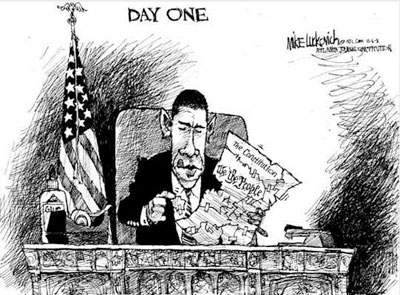
Now, I’m ashamed of that message. Coolness, measuredness, and calm, intellectual determination was the better way. These past eight years have whittled at my nerves. Professionalism derided, the persistence of anachronistic folly, a cretinous pride in ignorance, derision of international partners and collaborators, and an odd savagery raking at constitutional ontology, as Luckovich illustrates.

Picture-1.jpg

After my initial elation and disbelief at Barack Obama’s election, I’ve now slowed down to thoughtfulness, thinking of family, friends, colleagues, about change and the future. Bilal visited class yesterday and took my World Literature students through the history, contexts, and significant influences of the Koran. He’s a soft-spoken expert, and the students want him to return on Monday to continue the discussion, perhaps exploring different interpretations of certain sura. He persists in a large conversation over the public perception of Islam and the elegance of its ideas. In class we talked about the relations between Islam and T’ang poetry and we learned a lot about how people can elevate or destroy because of ignorance. I made the point that this is why we dig and dig into the poetry, not necessarily to know, but to engage and connect, not to punish but to come away humbled by openness.

The last eight years have not been about being humble.

…Ashamed though I am of my high position
While people lead unhappy lives,
Let us reasonably banish care
And just be friends, enjoying nature.
Though we have to go without fish and meat,
There are fruits and vegetables aplenty.
…We bow, we take our cups of wine,
We give our attention to beautiful poems.
When the mind is exalted, the body is lightened
And feels as if it could float in the wind.