Precision

I’ve been looking for the right word to describe the evaluation of problem solving processes. Today, while struggling with some evaluative language, it hit me: disassemble. That’s it.

We apply problem solving processes daily, even when we lose the keys. Ah, backtrack. We follow processes, but do we do enough to evaluate them when one aspect of work has been completed and implementation begins. Typically, implementation gets in the way because people are now working on implementation. This doesn’t seem quite right to me, as once implementation happens certain insights about how decisions were made might be lost and could influence engagements to come.

The above is a little cold and general. We should, I think, disassemble our thinking especially when we’re trying to learn something long term and reconsider processes.

Higher Math

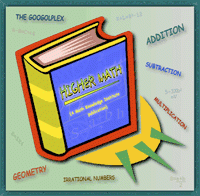
Alan Bigelow has a new webyarn called Higher Math. It’s his third in a the running brainstrips series.highermath.gif

Alan writes:

This newest work combines comic strips and other elements in an exploration of key concepts in math: addition, subtraction, irrational numbers, multiplication, geometry, and the Googolplex. Each concept has a human element, and their commonality, a bridge between math and ethics.

I particularly enjoyed “Subtraction,” which examines the ironies of finance through a particular plot of diminishing returns.

On Jazz

I’m driving full force into Alyn Shipton’s A New History of Jazz, although it is tough to read in bed due to size. But the size is worth the trouble. John Timmons and I have been doing more than a semester’s worth of work on the history and listening to lots of music and we’re planning some podcast discussions.

I first got into the music in high school when I played jazz band. I was a trumpeter and not half bad, earning first chair player as a freshman. I lost interest after graduating (turning to computer science and engineering) but my love of the music stayed. And we’re seeing lots of new media connections. The connections have a lot to do with cultural movement, transitions, and change. The transitions of jazz, relatively speaking, are swift. Ma Rainey to Miles Davis is not a lot of time difference.

Generally speaking, the music’s morphogenesis is mysterious and alluring. But it’s also palpably evident in its retentions–it has a persistent core set of ideas. Some historical questions seem obvious: jazz follows technological change both in instrumentation, writing (Jelly Roll Morton, for example), and recording device. But how? What are the details? What did the people on the street see? Shipton probes these areas to detail. I like it.

More Thoughts on Canons

George Landow concludes this about canons:

Doing away with the canon leaves one not with freedom but with hundreds of thousands of undiscriminated and hence unnoticeable works, with works we cannot see or notice or read. We must therefore learn to live with them, appreciate them, benefit from them, but, above all, remain suspicious of them.

The canon in academic settings has always been a problem and a subject for hot debate. Some of you remember the various ruckuses. But it’s a good problem and a practical question.

More specifically, and practically, what works of new media should our students experience in the two, three, four years we will have with them? If we were to generate a list of readings/experiences (on top of those in a foundational literary and other discipline core), what works should we suggest? This, again, is a practical question which is, I believe, Dr. Landow’s point. Even though we may argue with a current canon, we can’t really get buy without shared texts, common references from which to generate ideas. On the NMC website, we’ll probably have a suggested reading list and expect our students to show evidence that they’ve covered a certain number of the works since we can’t cover them all in schola. The body will be a “canon,” regardless of our opinion of canons in general. But the lists are long and several core ideas of enormous aid have already been generated.

We will be offering an interdisciplinary, foundations program. Students will be expected to transfer to university and pursue bachelor and graduate degrees when they complete their time at the college. This an additional issue. So, for these students what will be the new media canon?

On the one hand, the “competencies” are easier to define than the material. Introductory, and not too complex, Actionscripting provides solid programming framework, as does Inform 7 and other languages we teach, such as Java and C++. Even students who aren’t inclined to developing deeper skills with programming will have enough scripting frameworks for programming contexts. It works the other way too. The computer programming or engineering minded students will have opportunity to go fairly deeply into science and literature an to gain a certain amount of perspective in other disciplines. Critically, problem solving and coherence of expression are significant pieces of the puzzle.

So, it’s a simple question: what would be your list of essential new media reading for students working through a foundations program in college?

Notable submits:

Hopscotch

Elephant (van sant)
Imagery

Jeremy Jones on Harry R. Truman:

Every May the 18th, I think about Mt. St. Helens and specifically Harry R. Truman. Every year. I feel a strange bond with that man, even though we never actually spoke. It’s amazing what an impact on one’s life twenty or thirty letters from third and fourth graders can have. (Along those lines, please make sure your children write. It can make a huge difference in their lives.)

Professor Brown and the Weblog

My friend and writer Bob Brown has created a weblog. It will be interesting to see what he makes of it. He writes:

I am not really a technological Luddite, though I’d like to be right now. The reason? My PC has been attacked by something called a self-replicating virus, which sounds suspiciously like an online version of swine flu. I’ve been told that I’ll get my precious computer back sometime today, and I can’t wait. Meanwhile, I’m taking advantage of a long-standing offer by my friend, Rachel Hyland, to help me establish a blog of my very own. We’re sitting in her office, hunched over her computer, and I am experiencing an odd blend of exhilaration and dread.

Work

It’s been a long and short semester. Lots of evaluations yet to get through. But it’s also somewhat sad to see the semester go. My commitments to our Ability-based teaching and learning system have come to formal close, as chair of the team that developed, put into place, then revised, and again put into place over the past five years or so. Now it’s time to apply and put most of my time into developing our new New Media Communication program, which should see formal approvals in the fall. I’ll be coordinating the program.

Our prep students have taught us a lot about what to do and what not to do. And the work John and I do external to the college feeds the ideas and keeps us thinking freshly on digital subjects. We’re looking forward to interesting projects with Nathan Matias and others. We’re thinking about film, interactive fiction, hypertext, and code, but we’re also thinking about how to inject all this into curricula that can change quickly but also stay in touch with fundamentals.

Students in the new media area, where we’ve been paying most attention, have been very smart, fast, and amenable to the new but still need more background, background, such as the range of works encompassed by hypertext and computed artifacts, that’s difficult to generate when that material has not been covered seriously in their educations. They enter courses with lots of experience with digital tools. These tools simply exist, like those browning bananas you have in the kitchen. But they still haven’t read a lot of relevant texts, other than what they’ve either generated as content on social networks or on cameras or cell phone ephemera. It’s interesting that the history of the network is absent in their experience, in the very screens they consume.

A lot of our work has to do with understanding and conveying context. A weblog, for example, is a connection to . . . what . . . as Blake is a connection to . . . well . . . what? Like architecture, the forms are just there, always have been, like that red-brick apartment on the corner where you grew up, and thus they need revealing.

Here’s to the new media students. It’s been a blast.

Tunxis Stage

Drama is life exaggerated. What a thrill to see it in action at the college tonight. George Sebastian-Coleman with Patrice Hamilton performed three plays by Christoper Durang: The Book of Leviticus Show, Kitty the Waitress, and Funeral Parlor. In addition, we also had Patrice’s own short work, The Hail Mary Pass, to enjoy.

The actors were very good. Currie Ricci played a sensual Kitty. Amy DesRoches exposed the currents of bereavement in Funeral Parlor, Andrew Frederickson vulnerability as Jake in Hail Mary Pass, and Christine Rodrique awkward surprise at murder in Leviticus. But I thought Jim Revillini stole he show with interesting performances of Curt and Marcus. Energetic. Active. Natural.

Everyone did a great job.

I found the setup for the performances most intriguing. George arranged the audience around an intimate floor-level stage, with the first row of the fourth wall within easy reach of the actors and backdrop. The sets were effectively minimal, the lighting exquisite. The arrangement gave the impression that the audience was enclosed with the actors. Very interesting. Of course, this got me thinking about possibilities for hyperdrama.

We need much more of this at the college.