Category Archives: Culture

Politics and the Air

I watched a lot of news on Friday, following votes and commentary on the “stimulus,” tweeting reactions Over the past couple of weeks the waves have been filled with statements against, with two primary arguments: too much spending and not enough jobs and tax cuts. And in the shakier regions: socialism and big government. But mood and reality are not congruent here, whatever the CEO of Caterpillar claims.

Today, the papers herald the passing, forgetting the last two weeks. We had dire predictions: such a bill will “nail” big government into place, forgetting the last year of billions flowing out, and will turn us all into socialists. How the idea of yesterday has changed. Not a “jobs bill.” Good grief.

Not much went about about the “context” of the bill and the situations of others in the world, such as the UK. Our situation is pretty dire. But the meaning context of government involvement in decisions is, today, beyond authoritarianism. As Krugman writes:

Why do we need international cooperation? Because we have a globalized financial system in which a crisis that began with a bubble in Florida condos and California McMansions has caused monetary catastrophe in Iceland. We’re all in this together, and need a shared solution.

“The honorable gentleman cannot guarantee that this bill will work,” claimed a detractor yesterday. Right.

Taxes

Taxes are all the rage these days–again. What I’ve learned is that lots of people in positions of power avoid them in interesting ways. (Why lower a tax, therefore, if its value is empty. Logical flop, but fun nonetheless.) Who’d have thought that tax on driving would be worth over 100 Grand. I’m sure there’s a deeper story to Daschle’s tax issues , what he calls a “tax laps,” than has been made public, as would probably be the case with most in Congress.

Value is interesting question in whatever market. A service provided on the back of a tax is considered of less value by Republicans because more profit could be had by restructuring it in the market and it comes off as an “entitlement.” Public schools, for example, could be a neat business. But then a “market value” would be established, a windfall for some, an element of scarcity for others. Public learning as scarce commodity. Thrilling.

Shelby wants us to “attack the financial cancer” but has very few ideas beyond the 80’s cliche: cut taxes, the only idea Republicans have apparently. And Sununu’s in a state over some monster of a government policy too difficult to find in the dark. Do I disagree with Shelby and Sununu? Not really. But CT is heading toward a 4 Billion deficit in a few years and it’s not because of lower tax revenue. Causality? That’s a good one.

None of his is poetry or fiction. These are too honest.

Knowledge Use

The Courant has a sad article on mortgage relief in CT.

The Wrights, with yearly income of about $80,000, share a predicament with thousands of families in trouble in Connecticut — many of whom had reason to hope for help from the state. An examination of Connecticut’s mortgage relief programs shows that only a small fraction of homeowners have qualified for aid that was meant to reach many more families.

Even as foreclosures continue by the hundreds, more than $100 million set aside by the state to help families keep their homes is going untapped. The state programs are so narrow and carry so many restrictions that getting approval is nearly impossible.

From what I can gather from the article, there are several programs in CT and each comes with its own set of standards: EMAP, CTFAMILIES, and HERO:

Since July 1, a program to help homeowners make payments on their mortgages has helped one borrower so far, with just five approvals pending. That, despite 382 applications for the program — the Emergency Mortgage Assistance Program, or EMAP.

The centerpiece program, CTFAMLIES, has fared better, with 65 loan refinancings closed, totaling $13.5 million, among 309 applications. Another seven refinancings are approved, and awaiting a closing date.

In yet another program — the Homeowner Equity Recovery Program, or HERO — the state planned to buy mortgages from lenders, who would take a loss, and negotiate to set more affordable interest rates. HERO has yet to help a single homeowner, and just one loan is expected to close later this month, state records show.

These programs, according to the article, are managed by the Connecticut Housing Finance Authority. My intent here is not to write about the financials but to ask a few questions. If a relief program is going to be useful, it seems to me that a few important items are required: 1) develop a process to identify who needs assistance 2) develop a process for getting aid to them as painlessly as possible. Standards matter, but it’s not that difficult to develop them. Why do we need separate programs, which will confuse people having problems and looking for information and will put a lot of administrative load on the state and its employees?

Moreover, a quick look at the CHFA website is enough to confuse anyone or drive them bananas.

Soft News

Yet another article by Tom Condon on suburbia.

Suburbs have been developing for more than 100 years. A main problem with the explosive suburban growth after World War II, driven by such things as GI mortgages and cheap cars and gas, was its form. Low-density, auto-dependent sprawl might have made sense in an era of large families and 30-cent-a-gallon gas, but it is no longer sustainable. Burning fossil fuel is endangering the planet. Paving fields and forests is damaging the water supply. Sending people to exurban subdivisions is isolating them from other people.

Retrofitting the suburbs reduces car use, lowers household costs, increases time for social engagement and exercise, and improves air and water quality, the authors write. Between aging boomers and young “echo boomers,” there is an increasing market “for a more diverse selection of urban housing types and places.”

It’s good to keep up the voice on this, but there are very few examples of real spatial movement on the relations in CT. This is getting repetitious and soft. Where are the suburbs being retrofitted?

Drugs

A snip from my home town news paper, the El Paso Times

EL PASO – Mayor John Cook vetoed a unanimous vote by City Council that earlier Tuesday asked the federal governemnt to seriously study the idea of legalizing drugs in response to the violence that has plagued Juárez.

In what is the third veto of his administration, Cook said the council’s position “was not consistent with community standards both locally and nationally. I urge council to reconsider supporting the original wording as recommended.”

Council voted 8-0 earlier today to approve a resolution that outlined 11 steps the U.S. and Mexican governments needed to take to deal with the violence that has resulted in more than 1,600 homicides in Juárez.

South-West city Rep. Beto O’Rourke added a 12th step, which asked the U.S. government to have “an honest debate on the decriminalization of narcotics.”

I’m with Beto. But would decriminalization really put a sock in this incredible violence?

Popularity

Obama’s press reactions have been in the news a lot. I wish someone would do something about what happens to people in the public eye. I’ve heard the claim that if celebrities don’t want the exposure then they should get out of the business. This is bunk and always has been.

Consider an actor who happens to make it huge. When we break down the condition, we have an actor in a movie (or a man who’s voted into office), a person who maybe loves what they do, and can move on and do greater and greater things. Etymologically, celebrity has to do with amount of time (how many times you are aware of another person or place) and fame, thus kin to reputation in oral culture and heroism. But as people, we lose nothing in letting people get on with their business, especially now, when “getting on with business” in a post-ideological fashion might make some sense.

He can’t have his Blackberry and GW couldn’t email his kids. Shameful. One reason it worries me is because we have a lot of work to do and to let sham justifications bar solutions and decisions amounts to cracking more hulls. The cracks are widening and the water’s rising enough already.

Bailouts

hummer.jpgThe auto industry “bailout” is an odd thing. Canada is moving in kind. It seems to me that the money will last a few months, then issues will arise, the same as exist now.

Blame’s not an issue. American’s were purchasing, rather financing, weird cars for years. I still have to struggle in the parking lot with Suburbans and Excursions or whatever blocking off whatever treeline exists in CT.

What will happen in the next few months that changes anything? Here are a couple of ideas, though: put the northern industry into the hands of the union and designers and see what happens, such as re-equiping (see link below). Top management should reduce its paycheck to a 200K cap, even for the chiefs. If you can’t live on 200K (I have no idea what I would do with 200K–it would be interesting, maybe do some more insulating and give more to the groups and charities we give to now), then something’s wrong. Million dollar paychecks, in any economy, are bizarre and must be “overvalued.” Third, take Ray’s suggestion and run with it.

Hypertext and the Economy

The economy is in a bad way. People are suffering and there’s lots of fear:

Job losses are accelerating at a terrifying pace, with more than 1.25 million lost in the U.S. in the last three months, according to a U.S. Department of Labor report Friday. Unemployment jumped to 6.7 percent, the highest since 1993. Almost two million jobs have vanished since last December, with daily warnings of dire conditions ahead that could make this the worst recession since World War II. November’s job losses are the most in any month since 1974.

It seems to me that one of the ideas in germination since FDR and the explosion of road building with Eisenhower is the significance of the metaphor of distance. This metaphor saw new illumination in the 80s and 90s with the ecological spread of networks. Social networks now reformulate time and space with simple links. “What’s so ‘n so up to” meant something different when I was a kid. Now I visit a weblog and read.

I once lived in a house with mahogany deck railing. Such a house requires great distances passable by fuel and tarmac to exist. This kind of existential reality was once new and significant. I would imagine that a thinker could trace the change of perception of spatial economy by way of an ecological framework. A new energy infrastructure could provoke another round of change. Solar power, therefore, would imply another kind of railing for decks, just as swift rail would imply a different sort of decision making.

Distances matter in networks. Go to page 20 is much different than a note made available by a link. In relating ideas, hypertext is an epistemology of distance. In Graphs, Maps, and Trees, Moretti makes available demonstrations of relations between texts, which, in a way, shortens their distance between one another. What kind of relations, for example, exist between Beowulf and the Book of Songs?

It’s not that short a distance between relating Los Angeles and Hartford if a father could leap across that distance more quickly than by using a plane or re-conceiving the amount of energy expended to visit Boston from Bridgeport with the use of solar trains. Underlying any new technology is an ecology and an infrastructure and a new set of metaphors made tangible, like replanting beans where we once planted tobacco.

At the moment, the goods exist to create new markets for which people could make contributions. This is how literary ideas link to roads. New literary forms, new forms of travel, new forms of work. What’s the plan: we need this much new track, these many trains, this kind of energy, and this kind of skill to make it all work. And don’t forget the nano-solar paint to make cars look pretty and run well–and thus a new economy emerges. What hypertexts would follow from that?

Reading Leadership

Prior to the second debate between President-elect Barack Obama and John McCain, I sent a tweet to Obama saying “go get him. Don’t stand for cheap shots.”

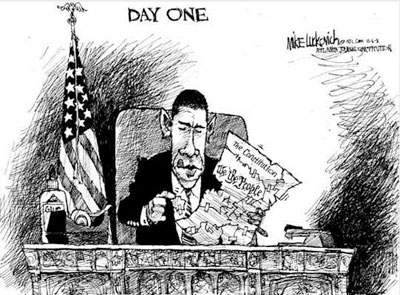
Now, I’m ashamed of that message. Coolness, measuredness, and calm, intellectual determination was the better way. These past eight years have whittled at my nerves. Professionalism derided, the persistence of anachronistic folly, a cretinous pride in ignorance, derision of international partners and collaborators, and an odd savagery raking at constitutional ontology, as Luckovich illustrates.

Picture-1.jpg

After my initial elation and disbelief at Barack Obama’s election, I’ve now slowed down to thoughtfulness, thinking of family, friends, colleagues, about change and the future. Bilal visited class yesterday and took my World Literature students through the history, contexts, and significant influences of the Koran. He’s a soft-spoken expert, and the students want him to return on Monday to continue the discussion, perhaps exploring different interpretations of certain sura. He persists in a large conversation over the public perception of Islam and the elegance of its ideas. In class we talked about the relations between Islam and T’ang poetry and we learned a lot about how people can elevate or destroy because of ignorance. I made the point that this is why we dig and dig into the poetry, not necessarily to know, but to engage and connect, not to punish but to come away humbled by openness.

The last eight years have not been about being humble.

…Ashamed though I am of my high position
While people lead unhappy lives,
Let us reasonably banish care
And just be friends, enjoying nature.
Though we have to go without fish and meat,
There are fruits and vegetables aplenty.
…We bow, we take our cups of wine,
We give our attention to beautiful poems.
When the mind is exalted, the body is lightened
And feels as if it could float in the wind.