Category Archives: New Media

Plato and Games

Roger Travis is doing an interesting series on Plato and video games. He asks this question:

Plato and video games together, then, can be a way of looking at an essential question in video game criticism: How can, and how should, immersion fit into the rest of culture?

It bears following. It’s provocative

The familiar myth of the cave, that is, is a mimesis in a mimesis in a mimesis. It finishes with the above passage, in which I contend Plato becomes the first video game designer. My point, as this mini-series develops, is going to be that the game of the cave—the competition for honors in commenting on the shadow-puppet play—gives us a framework for evaluating video games’ cultural potential and for shaping their cultural effects.

Higher Math

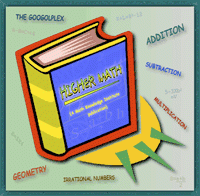
Alan Bigelow has a new webyarn called Higher Math. It’s his third in a the running brainstrips series.highermath.gif

Alan writes:

This newest work combines comic strips and other elements in an exploration of key concepts in math: addition, subtraction, irrational numbers, multiplication, geometry, and the Googolplex. Each concept has a human element, and their commonality, a bridge between math and ethics.

I particularly enjoyed “Subtraction,” which examines the ironies of finance through a particular plot of diminishing returns.

On Jazz

I’m driving full force into Alyn Shipton’s A New History of Jazz, although it is tough to read in bed due to size. But the size is worth the trouble. John Timmons and I have been doing more than a semester’s worth of work on the history and listening to lots of music and we’re planning some podcast discussions.

I first got into the music in high school when I played jazz band. I was a trumpeter and not half bad, earning first chair player as a freshman. I lost interest after graduating (turning to computer science and engineering) but my love of the music stayed. And we’re seeing lots of new media connections. The connections have a lot to do with cultural movement, transitions, and change. The transitions of jazz, relatively speaking, are swift. Ma Rainey to Miles Davis is not a lot of time difference.

Generally speaking, the music’s morphogenesis is mysterious and alluring. But it’s also palpably evident in its retentions–it has a persistent core set of ideas. Some historical questions seem obvious: jazz follows technological change both in instrumentation, writing (Jelly Roll Morton, for example), and recording device. But how? What are the details? What did the people on the street see? Shipton probes these areas to detail. I like it.

More Thoughts on Canons

George Landow concludes this about canons:

Doing away with the canon leaves one not with freedom but with hundreds of thousands of undiscriminated and hence unnoticeable works, with works we cannot see or notice or read. We must therefore learn to live with them, appreciate them, benefit from them, but, above all, remain suspicious of them.

The canon in academic settings has always been a problem and a subject for hot debate. Some of you remember the various ruckuses. But it’s a good problem and a practical question.

More specifically, and practically, what works of new media should our students experience in the two, three, four years we will have with them? If we were to generate a list of readings/experiences (on top of those in a foundational literary and other discipline core), what works should we suggest? This, again, is a practical question which is, I believe, Dr. Landow’s point. Even though we may argue with a current canon, we can’t really get buy without shared texts, common references from which to generate ideas. On the NMC website, we’ll probably have a suggested reading list and expect our students to show evidence that they’ve covered a certain number of the works since we can’t cover them all in schola. The body will be a “canon,” regardless of our opinion of canons in general. But the lists are long and several core ideas of enormous aid have already been generated.

We will be offering an interdisciplinary, foundations program. Students will be expected to transfer to university and pursue bachelor and graduate degrees when they complete their time at the college. This an additional issue. So, for these students what will be the new media canon?

On the one hand, the “competencies” are easier to define than the material. Introductory, and not too complex, Actionscripting provides solid programming framework, as does Inform 7 and other languages we teach, such as Java and C++. Even students who aren’t inclined to developing deeper skills with programming will have enough scripting frameworks for programming contexts. It works the other way too. The computer programming or engineering minded students will have opportunity to go fairly deeply into science and literature an to gain a certain amount of perspective in other disciplines. Critically, problem solving and coherence of expression are significant pieces of the puzzle.

So, it’s a simple question: what would be your list of essential new media reading for students working through a foundations program in college?

Notable submits:

Hopscotch

Elephant (van sant)

Work

It’s been a long and short semester. Lots of evaluations yet to get through. But it’s also somewhat sad to see the semester go. My commitments to our Ability-based teaching and learning system have come to formal close, as chair of the team that developed, put into place, then revised, and again put into place over the past five years or so. Now it’s time to apply and put most of my time into developing our new New Media Communication program, which should see formal approvals in the fall. I’ll be coordinating the program.

Our prep students have taught us a lot about what to do and what not to do. And the work John and I do external to the college feeds the ideas and keeps us thinking freshly on digital subjects. We’re looking forward to interesting projects with Nathan Matias and others. We’re thinking about film, interactive fiction, hypertext, and code, but we’re also thinking about how to inject all this into curricula that can change quickly but also stay in touch with fundamentals.

Students in the new media area, where we’ve been paying most attention, have been very smart, fast, and amenable to the new but still need more background, background, such as the range of works encompassed by hypertext and computed artifacts, that’s difficult to generate when that material has not been covered seriously in their educations. They enter courses with lots of experience with digital tools. These tools simply exist, like those browning bananas you have in the kitchen. But they still haven’t read a lot of relevant texts, other than what they’ve either generated as content on social networks or on cameras or cell phone ephemera. It’s interesting that the history of the network is absent in their experience, in the very screens they consume.

A lot of our work has to do with understanding and conveying context. A weblog, for example, is a connection to . . . what . . . as Blake is a connection to . . . well . . . what? Like architecture, the forms are just there, always have been, like that red-brick apartment on the corner where you grew up, and thus they need revealing.

Here’s to the new media students. It’s been a blast.

Games and Premises

I took a little rest from work this weekend and picked up Mirror’s Edge. The game is fun, some of the play is interesting, but the movement gets tiresome and the controls are just odd for my hands; I’ve been stuck in certain areas simply because I couldn’t nail the order of buttons, especially on 90 degree wall runs.

I’ve also been playing Pixel Junk’s Eden and find the simple beauty of this game much more satisfying than the big EA game. A few months ago I also played through thatgamecompany’s Flower effort and was just wowed by the art, concept, and sound. Both Flower and Eden are Ten dollar downloads on the PS3 and well worth the money; they carry more value than fifty dollar games.

One item interests me about Mirror’s Edge and Shadow of the Colossus in that both of these games make for interesting relationship between the controller and simulated human movement. In Colossus, we use the controller to have a knight jump on a horse, climb a colossus, tumble, and leap to and from ledges. In Mirror’s Edge, a first person perspective game, much like Half Life, the controller is used for leaping, sliding, clambering, balancing, and grasping for edges. Such games are pushing game controllers beyond their usefulness, however. In Colossus, for example, the knight will often jump several times for his horse and miss badly and awkwardly. This is often the case when a colossus is coming close and the player is in quick need of the horse but can’t get on, and he’s standing just beneath the horn of the saddle. Similarly, Faith in Mirror’s Edge will take a great leap and miss a pole on a wall because the controller’s crosshair is off just a tad to the left or right. Or, she leaps up to a pole and the effect is the same (of course, when I can’t line her up and struggling to aim her into the correct position, I start to groan, especially as the bullets are coming). It’s not the avatar’s fault. It’s mine given the “limits,” but there is something interesting about this whole controller business: the programming and controller choices.

Complex simulation is a technical question in Mirror’s Edge–Faith responds to the environment, for example, but only within a predetermined set of instances and never as an intelligent agent. She can’t, for example, adjust an angle to correct for player error. An avatar can jump on a box with the click of a button, but determining how to simulate complex human motion and human response–for example, the influence of momentum or the various kinds of impact and velocity or given an element of fatigue–with the typical game controller is reaching a comical limit in games that aim for high fidelity.

What are the limits of the technical model?

In Eden, for example, minimalism drives the controller as the world demands a specific kind of interaction: jumping, holding, and spinning. Flower, for example, wants the user to turn and rock the controller, which seems natural, as flight has been tied to rocking and stick motion in and outside of planes. While Mirror’s Edge aims for a high degree of representational value, the method of controlling Faith, the protagonist, just seems primitive. And boy do I have a pain in my right shoulder.
Flash Intro

In Digital Narrative, we’ve moved on to Flash. We have four weeks to create a banner and a short narrative. We opened with the interface and some basic animation principles and some discussion of object properties, such as color and size. But even that is incredibly intense.

Tuesday night: multiple content layers, more on properties and data types and object positioning.

Then we build the banner.

Overall, it’s also been an intense three weeks of teaching, which is why I haven’t been posting here. I’ve added lots of student presentations leading to discussions that wouldn’t have developed without students taking more control of the content and preparing more for sessions. I sit back and watch and probe when necessary.

But I’ve been waiting a long time to actually teach Flash. With Flash, despite the complexity, we can probe deeper into classes and objects and, best of all, the necessity of planning and preparation prior to even touching the library.

Web Literacy

David Millard on Literacies

Students tend to have poor Information Literacy, but good Web Literacy; this means that they do not have the search and research skills HE courses typically need, they find it difficult to assess information sources, and don’t appreciate plagiarism or respect attribution in the ways we might want. However, the same attitudes enable them to interact much more freely online, and they are able to merge their online and digital experiences much more effectively.